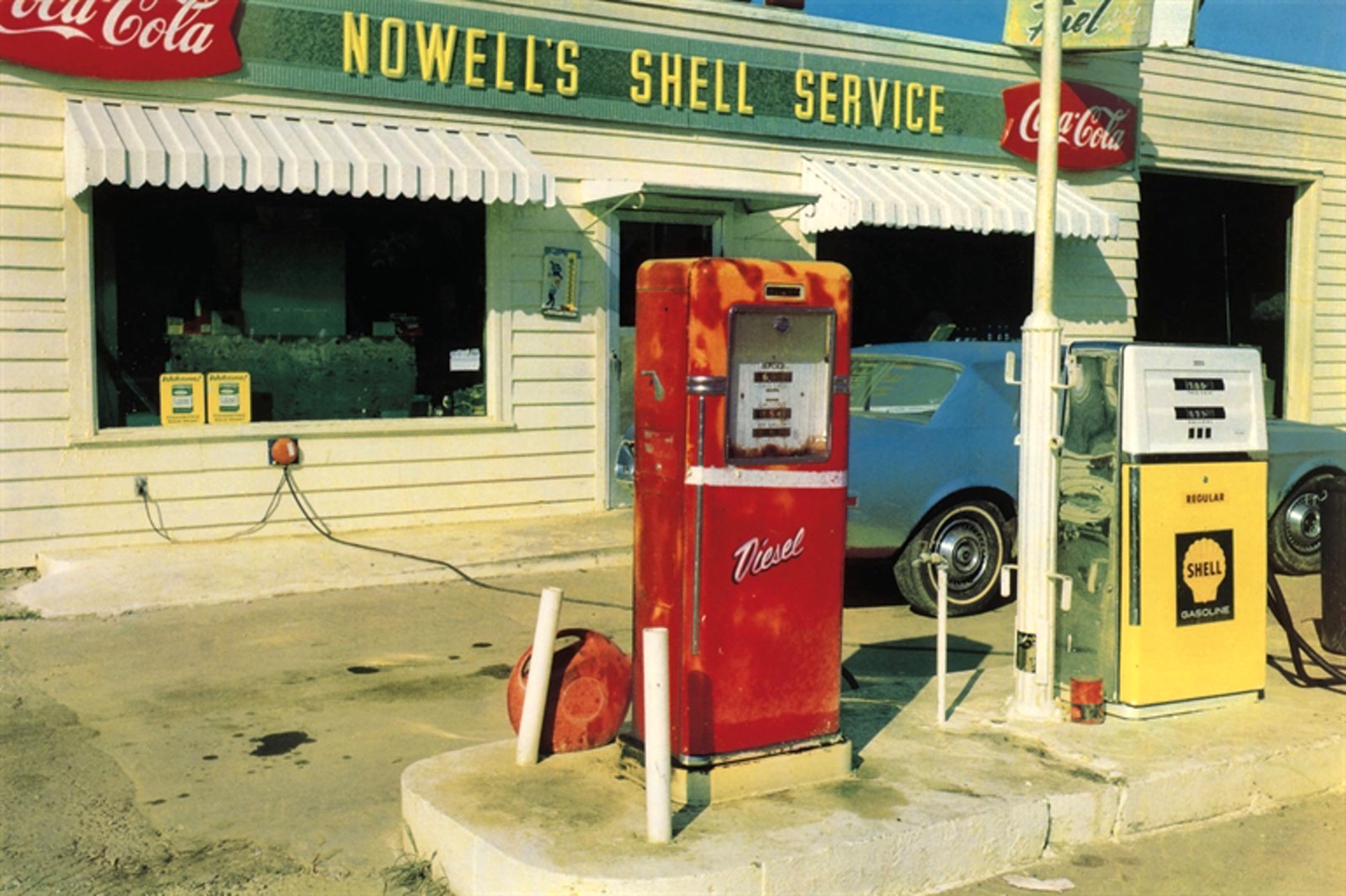
As a child of the 1960s, I am drawn to photos taken during my youth. Colors were primary; cars were large, loud, inefficient, and unapologetic. Gas stations were a way of life. No refilling every two weeks for that lot. You bought gas often and since it was cheap, you liked.
Filling stations were like the cars, bold and flamboyant, and since they sponsored pretty much every television program not hosted by tobacco companies, their logos were the way markers of life. Now, we have socially dysfunctional app makers to destroy society, but in the 1950s and 1960s, it was petroleum holding up (and quietly demolishing) our way of life.
Few captured this era like walk-around photographers Ernst Haas, who shot out of New York City, and William Eggleston, who patrolled the South looking for bits of urban/human markers among the lesser-populated spaces.


Kodak film was best with bold primarys: red, yellow, and blue, and paints used reflected that (or vice versa). Now, digital cameras’ ability to capture color and light is more refined and the ambient colors we surround ourselves with tax every millimeter of the artist’s color wheel.
In NYC, Ernst Haas frequented the streets, often capturing the city’s taxis’ brilliant red, yellow, and green hues.

As a writer, I have tried to capture this aesthetic, called dieselpunk, reflecting America’s and the world’s love affair with petroleum vehicles. I’ve merged it with Art Deco, in my head, watching the lines Art Deco’s decorists loved stretched in the long fins of car makers in the ’50s and ’60s so adored. I have written at least one science fiction short story in which an entire planet evolves into this aesthetic. How I wish I could visit there!

These themes are sprouting up in my art as well. I only that I become accomplished enough at them to make dieselpunk a true genre.


 The Artists' Sanctum