
Fans of photography know this iconic photo, taken by Dorothea Lange during the height of the Depression for the Farm Security Administration (FSA). Some, like me, even know the purported story behind the photo. But few know the whole truth.
The FSA captioned the photo, “Destitute pea pickers in California. Mother of seven children. Age thirty-two Nipomo, California,” and gave Lange credit for her work even though as a work-for-hire for the U.S. government, it was entirely within the public domain. Despite the “Migrant Mother’s” having been promised that the photo and her name would never be sold, Lange released it to the FSA who listed the woman as Florence Thompson, heralding her as representing the plight of similarly poor, white Americans suffering during the Depression. Florence, was, in fact, not a migrant worker, in the traditional sense, nor was she “white,” according to the narrow definition of the time.
She was born Florence Leona Christie in 1903 in Indian Territory, Oklahoma. Her father Jackson Christie, either full or half Cherokee, left the home before Florence was born, and her mother, Mary Jane Cobb, married Charles Akman of Choctaw descent. Mary Jane claimed she was Cherokee in 1894 when she married Jackson Christie, but later testified that both of her parents were white. Florence herself was either 1/4 or 1/2 Cherokee and was raised within the Indigenous culture.
At 17, Florence married Cleo Owens, a 23-year-old farmer’s son from Missouri. They quickly formed a family, first with daughter Violet, then Viola, then three more kids. The family, along with members of Cleo’s extended family, moved west to Oroville, California where they worked in Sacramento Valley’s saw mills. In 1931, after ten years of marriage, Florence was pregnant with her sixth child, and Cleo died from tuberculosis.
Florence didn’t fold. She had Cleo’s last child, then began working in the fields and local restaurants to support her six children. She met someone, had another kid in 1933, and moved back home to Oklahoma. Shortly thereafter, the widow, her seven children, and her parents moved with her to Shafter, north of Bakersfield, California. There, she met Jim Hill, with whom she had three more kids.
Throughout the 1930s, the family followed California and Arizona crops, working, as the FSA stated, as migrant farm workers. But it wasn’t all Florence did. She said, later, “I worked in hospitals. I tended bar. I cooked. I worked in the fields. I done a little bit of everything to make a living for my kids.”
On March 6, 1936, Florence, Jim, were traveling on Route 101, headed to the Pajaro Valley in California, hoping to earn cash picking lettuce. Their car’s timing chain broke, and Jim, her partner, but not her husband, took two of Thompson’s sons to get parts to fix the car. Florence set up camp, surprised to find 2,500 or 3,500 other hungry people whose plans to pick peas in the local fields had gone awry. Florence was not a part of that group. She’d just happened to get stranded among them. As she waited, planning to resume her trip, Dorothea Lange showed up.
Lange promised a reluctant Florence she wouldn’t use or sell the photos, and then took 7 shots. Her promise was a lie, of course, since she had sold the photographs before she took them. The usually diligent Lange was rushing and took no notes. When she submitted her photographs from the camp, Thompson’s photos weren’t mention. Later, Lange recalled, “I did not ask her name or her history. She told me her age, that she was 32. She said that they had been living on frozen vegetables from the surrounding fields and birds that the children killed. She had just sold the tires from her car to buy food.”
None of that was true, except for Florence’s age, 32. Troy Thompson, Florence’s son, didn’t believe the photographer was purposely lying. She simply rushed, made no notes, and confused one family with another. Florence and her family, icons of the horrors of migrant workers stranded in a field because the pea crops froze over, just happened to be a single, poor widow with a boyfriend and broke-down Hudson who was just passing through at the wrong, or historically, right time.
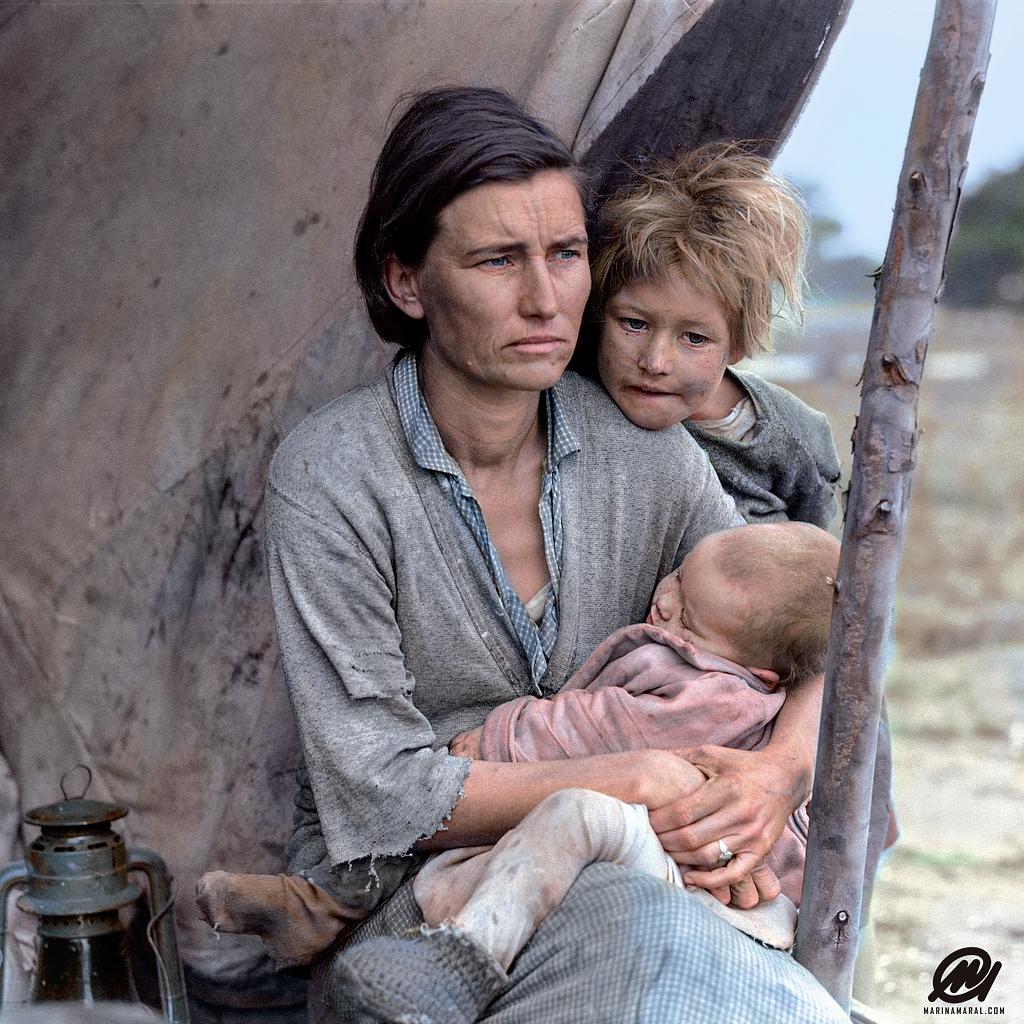

In the grand scape of things, the historical inaccuracies of listing Florence and her kids as migrant pea pickers instead of survivors of the Dust Bowl are not meaningful. Neither is implying she was representative of one ethnicity, when she was, in fact, of mixed heritage. Finally, she wasn’t a poor mother overwhelmed by poverty. She was hot and tired from being on the road, and a widowed survivor who eventually raised 10 children. It does not matter that Dorothea Lange got the details wrong, or even that she misled Florence, who hated the photos, to get the shot.
What does matter is that Florence’s truth deserved to be heard.


 The Artists' Sanctum